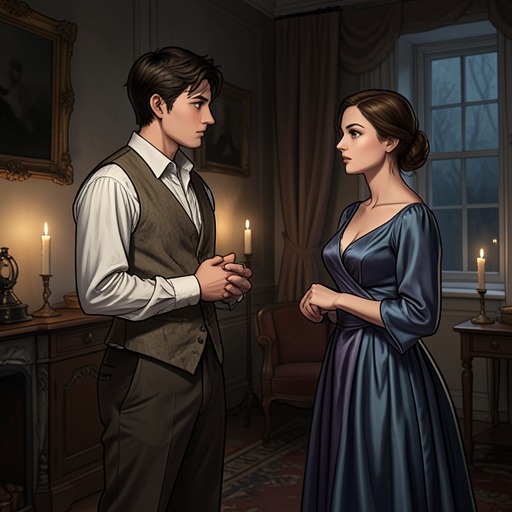
Dora’s fatal illness
David CopperfieldDora’s fatal illness transforms married life into a vigil. As her health declines, she becomes unable to move about as before and eventually lies in bed throughout the day; David Copperfield, Betsey Trotwood, and Agnes Wickfield gather around her. Dora continues to meet their care with affection and apparent hope, while David struggles to accept that she may die. The account makes illness consequential not through a named diagnosis or medical explanation, but through altered routines, intimate acts of care, and the widening distance between Dora’s confidence and David’s fear.
Course and Experience
David recalls Dora’s illness from within a retrospective narrative that repeatedly returns to personal memory. The period resists easy measurement: he cannot say how long she has been ill, and explains that he has grown so accustomed to the fact of her illness that he cannot count the time. In weeks or months it is not long, but to him it has become a weary, extended experience. The contrast between calendar time and lived duration conveys how care and apprehension make the days seem to accumulate.
At first, others ask David to wait a few more days, leaving open the prospect of improvement. That reassurance stops. He begins to fear that the day when Dora might again run in the sunlight with Jip will never come. His fear is expressed through a lost ordinary future: not a grand ambition, but Dora moving freely outdoors with her old companion. As her condition advances, she no longer goes up and down the stairs. David describes having stopped carrying her, and finds her lying in bed all day. The changed routine marks a decline in her independence without specifying its medical cause.
Care at Home
The illness reorganizes the household around Dora’s bedside. David sits beside her, and Betsey Trotwood remains active and wakeful despite getting no sleep. Dora recognizes their efforts: she understands that David is tiring himself and that Betsey is staying up to care for her. Her gratitude and attention to their needs persist even as she is the one receiving care. The scene presents her not only as the object of concern but as someone still attentive to the people around her.
Agnes Wickfield comes to the house and spends a full day and evening with Dora, Betsey, and David. They do not talk much, yet Dora is content and cheerful in their company. When the others are no longer gathered around her, David and Dora are alone together. This pattern of shared attendance followed by private conversation makes the vigil both communal and intimate: the illness draws trusted companions close, while leaving David to face his fear directly in the marriage’s most private space.
Jip’s decline accompanies Dora’s. He grows old, his sight weakens, and his limbs become feeble; rather than objecting to Betsey Trotwood, as he once did, he creeps near her while she sits by Dora’s bed and gently licks her hand. His changed behavior registers the illness’s effect on the household through the familiar companion’s own vulnerability. Later, Jip lies down at David’s feet and dies with a plaintive cry. His death occurs within the bedside vigil, deepening its sense of loss without replacing Dora’s illness as its central concern.
Hope, Fear, and Loss
Dora continues to speak as though recovery is near. When David urges her to get well soon so that they may have happy days, she replies that she will do so and says she feels much better. Her optimism stands beside his growing apprehension, not as proof that she has recovered but as a distinct response to the situation. The contrast gives their exchanges tenderness and tension: David hears the possibility of another future, yet increasingly fears that it will not arrive.
His uncertainty is especially stark when he has been told that Dora will soon leave him. The news is not new to his thoughts, but he cannot make himself fully believe it. He withdraws to weep and tries to find consolation in religious reflection, yet cannot firmly accept that the end is certain. Holding Dora’s hand and feeling the strength of her love, he continues to entertain the possibility that she will be spared. The illness thus brings knowledge and acceptance out of step: David has heard what may happen, but emotionally remains caught between the expected loss and a lingering hope.
Narrative Significance
The illness is presented through David’s first-person recollection, so its duration is shaped by the consciousness of someone both caring for Dora and unable to master the prospect of losing her. The narrative moves between repeated domestic details—the same bedside, the same chair, the visitors, the changes in Jip—and the large fact David cannot settle in his mind. Its restraint keeps attention on lived experience: the passing of days, reduced mobility, wakefulness, and the tenderness of Dora’s exchanges with those around her.
Dora’s decline also exposes a difference between outward composure and the emotional pressures of the vigil. She remains gentle, cheerful, and grateful, while David privately grieves and doubts that she will recover. The account does not give a medical explanation for her condition; instead, it shows the consequences that can be observed by those near her and the difficulty of accepting what they fear. Jip’s death near her bedside intensifies the household’s exposure to mortality. Dora’s illness culminates in her death, turning the shared home and its ordinary routines into the setting for David’s painful recognition that love and care cannot guarantee recovery.